Aruba recently posted a rather snarky post about the technological shortsightedness and irrelevance of 802.11ac upgradability of todays wireless infrastructures. This original post (mirrored here) admittedly ruffled my feathers on several fronts so I wrote this response. If you haven’t read these, I encourage you to go do that now.
Aruba product marketing manager, Ozer (@ozwifi) replied to my reply. Before we get to the meat of this post, in the interest of full-disclosure, this post has no direct ties to the Wireless Tech Field day events hosted by Gestalt IT. I have been selected as a delegate for the upcoming Wireless Tech Field Day event that Aruba (among others) has sponsored in the past. As a Tech Field Day delegate I have been given access to hardware and solutions from the event sponsors to utilize as I see fit. At the time of this writing, Aruba is not currently listed as a sponsor of the WFD3 event, but we certainly welcome them and look forward to their involvement!
Ding Ding!
Hey Sam,
It is @ozwifi here. It is not uncommon that we get on each other’s nerves in the Wi-Fi industry and by the tone of your reply I am guessing that’s exactly what we did. But you gotta admit, there are no personal attacks in the blog entry since it is delivering an educated technical opinion.
Oz! Good to hear from you. I apologize for the rather public response to your post, but this seemed the fairest way to address this in its entirety. To the audience at large, I apologize for the broken up, threaded reply and will do my best to make it as cohesive as possible. You are indeed correct that it’s not uncommon to get on each others nerves and you are spot on that this one hit home for me. Perhaps I shouldn’t be so personally vested in industry vision, but I’m sure it’s one of many faults that I have. 🙂 You are correct that there are no personal attacks in the Aruba post and I hope that no one believes that my reply was somehow a personal attack on the Aruba team – infact the only team I mentioned explicitly was the executive team and I certainly don’t hope they *actually* jump off the top of the tallest building in San Jose. That would not be pretty or professional and was merely a ‘leaping’ analogy. Regarding the blog post being an ‘educated technical opinion’, I do take exception to this being an educated technical opinion. It doesn’t sound educated whatsoever and I think that Aruba’s shortsightedness regarding 802.11ac is rampant in the article. Also, I’m still interested in just what the heck a 2400 is…
Poking fun at Aruba’s #1 competitor in the WLAN space with a bit of humour. You have to meet with the author, Scott, during the next WFD – he is not that bad of a person as you might think. So there is really not much to be ashamed of since we are not proposing the kidnapping of new born puppies.
Indeed I look forward to meeting him in person and we look forward to Aruba participating in another lively discussion this year! Also for the record, I wholeheartedly disagree with kidnapping new born puppies.
Before we talk tech – please leave your comments on our website.
I did indeed leave exactly my reply on the Aruba website and as of now, the post has not been approved and is not present in your comments section. To contrast, your post to my replies section was almost immediately approved. I welcome the conversation and look forward to Aruba being more transparent about their comments in the future.
First we do not have many people leaving comments, so we can use some. Second we are not that evil – look at our YouTube channel… anyone can say whatever they want. Unless it is personal attacks of course, cause that’s just not cool.
Alright, let’s talk tech.
Here is where Aruba stands:
1. We believe that dedicated AP hardware is going to provide the best coverage & capacity. Best antenna choices, speeds & feeds optimized for 11ac. If it was such a great thing to install modules on an AP in terms of either of these two, many WLAN vendors including us would have jumped on the bandwagon.
There will always be advances in technology and I believe that most any new solution will ultimately outperform legacy solutions. We see this time and again in the industry and this is a byproduct of Moore’s law. The 802.11ac module is about investment protection. The message from Aruba is clear: either a) don’t buy a 3SS AP today and wait till the 802.11ac AP comes out in the future or b) buy two Access Points (3SS today and 802.11ac tomorrow). Cisco has an option that addresses this concern head on. Aruba does not.
2. Since we are a WLAN company, you will not be too far off in assuming that we will an 11ac AP available down the road. That’s a given. I cannot tell you when, what, how since the info is still very much confidential and shared under NDA.
Of course! This adherence to an NDA is critical in our industry and competitive speculation beyond NDA is what Aruba is good at. This is FUD until you can empirically prove otherwise (more on this later).
3. We are obviously not going to stop promoting AP-130 series product line. We educate our customers regarding the benefits of first gen 11ac and second gen 11ac all day everyday. We do not hide information or try to corner them into buying 130 series. That will be very wrong. Upgrading to dedicated 11ac AP from Aruba 11n will require same process that folks are used to performing during the last 10 years – climb the ladder, plug out AP, plug in AP. As opposed to Cisco, we are not proposing a change in this process. There are no hidden costs here.
I have every expectation that Cisco will not only have a dedicated 1-st gen 802.11ac Access Point in the future, but will also have a 2nd gen and whatever comes after that. The market is always evolving. Cisco’s message today is that the price of two Access Points from Aruba is more than the 3600 + a 1st gen 802.11ac module. Again, investment protection. The costs that Cisco is addressing with this module are not hidden. They are outright and Cisco is head-on tackling this proactively. Aruba is behind the 8-ball and does not offer investment protection. If I were an Aruba customer, I’d not buy new Access Points today because there is no low-cost upgrade path to 802.11ac in the future. Either that or write your check out to ‘Aruba Catalog of Compromise’. ‘Aruba Catalog of Shortsightedness’? ‘Aruba Catalog of Technical Irrelevance’? ‘Aruba Catalog of FUD’? I don’t know – pick one, they all work for me.
Here are my comments on your responses for what they are worth. I am guessing that we will agree to disagree at the end of it… although I hope I can provide more color commentary and that you will find them useful. Again, I am trying to talk tech here not disagreeing with the fact that 3600 11ac module is good marketing.
Oz, I 100% agree with everything you said here and am speechless that we’re so in sync! 🙂
1250 series: Folks invested in the platform found out later that there was no need for this modular AP since moving from draft 2.0 of the standard to the ratified version did not require an hardware upgrade.
We see this time and again with the Cisco product lineup. The radio modularity in the 1220s was upgrade investment protection for 802.11G. The radio modularity in the 1252s was upgrade investment protection for 802.11n. The radio modularity in the 3600 is upgrade investment protection for 802.11ac. There is a trend here.
Cisco’s predictions were wrong.
No, infact Cisco’s predictions were right! They took a ‘best guess’ at the hardware that it would take to support the finally ratified specification and there was never a module released because it was never needed. No hardware changes required was a win-win for Cisco customers.
It was a 5-pound AP
Auxiliary boat anchor, yes. It was heavy. Don’t beat up on it because it was big-boned. It needed that modularity. It’s mommy told it so.
with no dual-radio support 802.3af (if you rememeber, Cisco was claiming at the time that 11n APs will not be able to support 802.3af).
Unfortunately, you’re wrong here. The 1252 does indeed support 802.11n on both radios utilizing 802.3af. Quit spreading flat out lies.
I believe that 1250 series was mostly about marketing, capturing attention and not so much about delivering best of breed Wi-Fi technology. Given that the product line lived only about a year, on this side of the fence we think that our predictions about those first generation of 11n APs were the right ones.
1 year, huh? I show final date of support for the 1252 as early 2017. My memory isn’t all that clear on the 1252 launch date, but it was first supported in WLC code 4.2.61.0 which has a release date of March 21, 2011. My math is a bit fuzzy on this one, but 2011 to 2017 seems a much larger window than 1 year.
Difficult to deploy: Here is the Cisco process… Install 3600 today. Wait 8 months. Buy 11ac modules. Climb up the ladder. Unscrew the mounting bracket. Take the AP down. Install module. Climb up the ladder. Screw back the mounting bracket.
The vast majority of the installations I see are ‘snap in’ mount. I don’t recall how the Aruba 130 mount bracket works, but palming the butt of an AP to snap it out of place and snapping a module in seems pretty straightforward to me.
Cisco *will* come up with their dedicated 11ac AP hardware that’s based on Marvell chipset, as opposed Broadcom running inside the 11ac module for the 3600.
I do not have technical documentation about the chipset in the 802.11ac module from Cisco. This would be the first time Cisco has used Broadcom in an infrastructure device and would certainly be a departure from their M.O. Having said that, if you have NDA insight into the hardware diagram and working structure of the AP, I believe this would be covered by NDA and subject to change. Either way, you’re speculating or sharing data that is NDA and is subject to change. We’ll have to agree to disagree until the module comes out and we can take it apart and do performance testing with it.
With that upgrade, that’s three trips to the ceiling. And when the 2nd gen 11ac AP comes out, you do it again. That’s four. We cannot call this simple as opposed to difficult.
I still have 1252s in place today. They service a need for many of my customers that simply need to support 802.11n. I foresee that the 802.11ac module will support 1st gen 802.11ac needs for a long time. Aruba has no products today that can be purchased and upgraded later. Again, upgrade investment protection.
CPU speeds: Here is the thought process. Aruba AP-135 beats Cisco 3600 in peak performance. Whether it is pure 3×3:3 MIMO laptops, UDP or TCP traffic flows, or a mix of smartphones, tablets, laptops… that’s what we see using Cisco release 7.2 and Aruba release 6.1.3.2. Aruba product managers prefer not to use AP-135 CPU and memory subsystems for an 11ac AP per our interviews in order to be able to deliver the best peak 11ac performance. This tells me that Cisco product managers have to think the same way since AP-135 outperforms Cisco 3600. Using your argument, although looking at it from a different angle, how can we be sure that Cisco 3600 plus an 11ac module will deliver greater performance than a dedicated 11ac AP hardware?
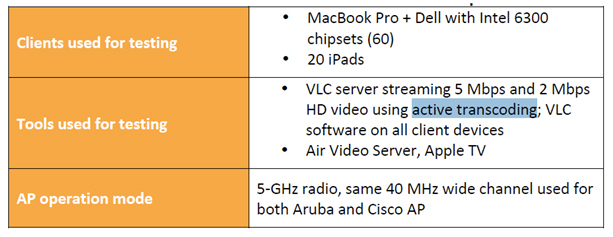
We can’t until it’s out and available. Regarding your other performance claims, I welcome those head-on and would encourage readers to visit ciscobeatsarubayetagain.com. Aruba has addressed these performance tests inconclusively (performing iPad throughput tests with Android devices, transcoding their video down to lower bit rates, and disabling recommended enterprise feature sets such as spectrum analysis and IDS). When will we see Aruba engage a 3rd party like Miercom to do independently validated performance tests instead of continuing to poke and prod at Cisco? Let’s back your claims up independently. As an aside, I welcome the performance claims of existing hardware but it’s off-topic for this thread.
Inconsistent RF and feature set: 3600 will run two separate Wi-Fi chipsets from two different vendors: Broadcom and Marvell. Why on earth would I want to do this if I want uniform features and functionality across my 2.4GHz and 5GHz radios? No AP that was built for enterprise WLANs ever had this design. I am sure there was a good reason behind it.
Adressed above.
Upgrades: Cisco 3600 requires 7.2 release, which requires latest generation of Cisco controllers and NCS management instead of WCS management. We are just making it more apparent for those who care, although Cisco release notes clearly state these facts as well. The tradition of having to upgrade something in your network whenever there is a new WLAN product or solution from Cisco is really what gets on our nerves. For instance ISE… BYOD solution that requires me to upgrade from ISR to ISR G2… why would I want to touch my branch router if there is an employee owned iPad connecting to my network? Some of this stuff just does not make sense to us and we have just watched this episode way too many times … hence it is a reflex motion… we do not miss an opportunity to remind folks of what they need to be careful about.
I’d like to hear more about your ISR concerns. I’m not sure where the mindset of routers being upgraded to support your iPad comes from. The iPad is not a wired device. Are you referring to the AP801/802 module? Both of those are integrated into the ISR and fully supported in 7.2 code. If you have a switch that supports ISE, there is no need to replace the router between the switch and the Access Point. Although, I always liked the idea of cabling my iPad to my ISR router…
Alright my apologies for the long comment post, tried to do my best to keep it short. I hope you can give me a chance to respond by accepting my comments.
Your comments are always welcome (despite being shunned on the Aruba post comments) and I apologize again for the threaded response. If you’ve read this far, I formally invite Oz (and Scott for that matter) to come onto the No Strings Attached Show and discuss Arubas stance on 802.11ac. I look forward with taking more about this in a forum more conducive to back and forth dialogue.
See you at WFD3.
I as well as the entire WFD3 delegate team most certainly look forward to Arubas participation. I recall last year being lively and look forward to it!
-Sam














 I gotta tell you I love the “ding-ding” opening! I am glad that we can keep the discussion fun, engaging instead of using anger and personal attacks… Thanks again for accepting my reply, glad to have the discussion going. BTW, you type fast!
 SC-WiFi